Showing posts with label agility training. Show all posts

Friday, January 31, 2014

Agility Training - Running Contacts vs. Stopped Contacts


In agility there are many decisions a handler has to make while training their dog. You have to decide what their criteria will be on all of the obstacles. There are some obstacles where the criteria is already determined, like weave poles. The dog must weave through all of the poles, and must enter with their left shoulder to the first pole. We don’t get to choose that. The training methods may vary, but the end result is basically the same. Most obstacles are this way, but there are some where you have to choose how to get to the end result. The biggest “criteria choice” handlers have is their contact performance.

Contact performance can vary depending on the dogs speed, size, or even their confidence level. Everyone has their own personal preference, and may make a decision based on their past experiences or on the dog they have now. 

Handlers can choose from “running contacts” or “stopped contacts.” As you begin agility training, learning the difference between running contacts and stopped contacts can help you choose how to train your pet. There are some pros and cons to both:

Running Contacts: Running contacts are when the dog continues at full speed and strides down into the contact zone. A true running contact has no deceleration. There are many methods to training this performance. Some include teaching the dog to foot target, or teaching them to control their stride down the contact.

Pros to running contacts:

  • Running contacts take less time for the dog to perform because they never stop until the end, so it will contribute to a faster course time.
  • Running contacts do not put as much physical wear and tear on a dogs body, because we are not asking them to stop on an incline at high speed.
  • For environment sensitive dogs, running contacts keep the dog moving, so they don’t have time to think about the environment and get distracted.

Cons to running contacts:

  • For handlers that need a physical advantage over their dog, running contacts do not give the handler a chance to get ahead.
  • Running contacts take lots of repetitive training and commitment, and will take longer to train consistently than a stopped contact.
  • A running contact performance is not as consistent of a behavior as a stopped contact, it’s nearly impossible to make sure the dogs feet are in exactly the same place each time.
  • Turns off a contact have to be trained very well. The dog must really understand how to run through the contact but turn as soon as they hit the ground.
  • Running contacts make it more difficult for this obstacle to become independent.
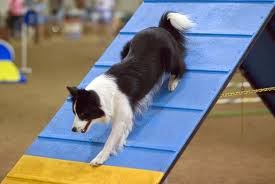
Border Collie on A-Frame must "hit" the yellow area in stride

Stopped Contacts: Stopped contacts, usually a “2 on 2 off” behavior, is when the dog stops at the end of the contact with their two rear feet still on the contact, and their two front feet on the ground. The dog would then be released by the handler before continuing forward. There are many methods to teaching stopped contacts. Some include a nose target, while lots of people will shape the behavior.

Pros to Stopped Contacts:

  • Stopped contacts give the handler a chance to get ahead of their dog.
  • Stopped contacts may not take as much training time and commitment as running contacts.
  • There is no question if the dog has hit the contact or not, because they should be stopped in the contact zone.
  • Sequencing off of the contact can be easier because the handler has a chance to position themselves where they need to be. This also means that the dog can turn off the contact with the handler, they don’t necessarily have to be driving straight.
  • Stopped contacts are an easier position to teach independently.

Cons to Stopped Contacts:
  • Stopped contacts add to your course time, because the dog is stopping, even if just for a brief moment.
  • For environment sensitive dogs, stopped contacts give the dog a chance to look at their surroundings, like the judge standing nearby or the busy situation of a trial, which could lead to the dog getting distracted.
  • Stopped contacts require more impulse control for the dog, because they have to wait to be released. A common problem for high drive or fast dogs is that at competition, they are too amped-up to stop.
German Shepherd would allow board to hit the ground in a stopped contact.
His 2 back feet should be on the yellow board with his 2 front feet on the ground waiting for instruction.

These contact positions can always be modified, depending on what works best for your dog. When choosing one for your dog, think about the following things:
  • Is speed something you are concerned with? Do you mind that stopped contacts will take a few more seconds, or do you want the fast running contacts because you want a better course time?
  • How much time are you willing or able to commit to the training? Our lives can be busy and not everyone has the time or place to train every day or even every week. Figure out what time you can commit. Running contacts take more consistent training and more repetition. If you are only going to class once a week, a stopped contact may be more realistic.
  • Figure out what is best for your dog. Is your dog comfortable enough in the competition environment to stop and wait to be released, or is it best for them to keep moving?
3rd Contact Obstacle known as the dog walk.
 The dog should be hitting the yellow at the end of the board before moving on in the course
Regardless of which performance you choose, you can be successful with either one. We’d love to hear your opinions on the different contact positions, and what works best for you! Comment or e-mail your stories to agility@morrisk9campus.com.

Friday, January 3, 2014

Agility Training - To Compete or Not Compete?


So you’ve been training with your dog in agility for a while and you think you might be ready to compete. But how do you know for sure? The most important thing to remember is that every dog is different. Dogs mature differently and have varying confidence levels. While some dogs are ready to go at 15 months (the minimum age in most agility venues to start competing), others may need more time. There are many things to consider when deciding to compete for the first time. Take the following steps to help determine if you and your pooch are ready to move forward.

Get your dog comfortable in the environment. Lots of agility trials are held in barns or at indoor sports facilities with surroundings dogs have never encountered before. Your dog must be comfortable around unfamiliar dogs, people and noises in different situations. Agility trials can also get very loud and crowded, so it’s important that your dog is exposed to that prior to competing. 

When you first get a new dog - puppy or older - consider taking them with you when you travel, especially if you already attend agility events. Most show grounds allow puppies older than four months. Exposure to this kind of stimulus in a positive way will help your dog become more at ease with things they will encounter during their future agility career.

Have a solid set of skills. Prior to competition, your dog should be able to accurately complete all obstacles to the criteria you have chosen. For example, if you have trained a stopped contact, your dog should perform that behavior with confidence anywhere. If a dog is unsure on an obstacle, competition could make them even less sure of themselves and could result in the dog shutting down.  

Attend a Match or Run-Thru. Test your pet’s confidence with an agility match show or run-thru. This is basically a fake trial; it gives your dog exposure to agility in another location while being around other people and dogs. Most places allow you to use training aids during these events, such as food, toys or clickers. Keep these trial sessions short, successful and happy. 

Morris K9 Campus offers run-thru’s and match-style competitions for agility training participants to provide them with a chance to practice. If you feel ready to take the next step, consider signing up for one of our upcoming trials. 

Don’t be nervous! As a handler, sometimes your first competition can be nerve wracking. Be careful of getting too nervous at the match. Dogs pick up your emotions, so being nervous is not going to help your dog. Try to remember this is only a game, and that no matter how your run goes, there are people there to support you. 

Choose the right trial. Once you feel confident in yourself and you are seeing confidence and performance from your dog , you are ready to find a trial to enter! Smaller trials are often a little less intimidating. Some clubs even hold Novice only trials. Ask around and see what facilities people recommend for beginner dogs if you haven’t been to one before. 

Record and report. After your trial, report back to your instructor about how things went. It’s always a good idea to find someone to videotape your run. If things went well, pick a few trials to go to next. You don’t want to overwhelm your dog, so stick with the occasional trial to start. If things didn’t go as well as you hoped, make a training plan and try again later. There will always be trials to go to, so don’t rush it. Let your dog blossom at their own rate, and as always, enjoy the time spent together. At the end of the day, agility is a sport that can and should be enjoyed by all participants.

Friday, August 16, 2013

Agility Release Cues - Off the Body vs. Verbal Do You Understand the Difference?

If you practice agility with your dog, have you ever wondered why your dog breaks the start line even though you've told them to stay?
Here's something handlers don't always think about: When we ask our dogs to stay, how long do we expect them to stay there? How do they know when they are allowed to move? What do we do to let them know they can move? All of these questions are the reasons for "release cues". 
A release cue is a word, common words are "okay", "free" or "break", that releases or lets the dog know they can move off of a stay. In agility, we use release cues for multiple behaviors.  The most common place for a release cue in agility is at the start line. The start line is the first obstacle in a course, usually a jump. Most handlers will leave their dog in a stay and walk past the start line so that they are ahead, and have a physical advantage over the dog. This is called "leading out". 


A very common issue handlers have in agility is their dog breaking the lead out position before they are ready to release them. Unfortunately, many handlers blame their dog or get upset because their dog did not wait to be released, when really the whole time they have been training their dog to release off their body movement, rather the verbal word. 
How does that happen? When teaching your dog a release word, many handlers will pair a hand movement with the verbal word. If the dog is always released with a moving hand and verbal, they are going to look for the moving hand more often than they would listen for a verbal. Dogs are very physical, and while of course people have been teaching dogs verbal commands for years, a body cue is always going to be stronger.
If you find your dog breaking when you haven't released them, make sure you aren't releasing with a body cue. To test for this, you can practice releasing your dog with no movement, and rewarding after they have broken and gotten to you.
 
Livvy's handler leads out, looks at her, does not move, and uses the word "ok" to release her

When you lead out, it is a good idea to have your dog stay for different amounts of time. Sometimes you can release right away, or other times stand and look at them for a few seconds before releasing, so they get used to your signal rather than the amount of time. The release word is key, so if your dog understands that the release word is when they can break their stay, they should not break on a body cue.
We are pleased to have Christina, one of our instructors at Morris K9 Campus, as a contributing writer for A Dog’s Life.


Friday, July 5, 2013

What is agility?


Agility, in basic terms, is an obstacle course that dogs run while the handler directs them where to go.  In competition, people compete for titles. To someone who has worked hard training their dog and putting lots of time into getting ready for competition, nothing is more gratifying than being successful and earning a title.

If you were to survey participants at an agility competition, also know as an agility “trial,” “match” or “show,” they would all have different ways to define agility. However, from the highest level of competition to someone just practicing agility in their backyard, the common idea is to have fun with your dog! Agility is a sport, in which the ultimate goal is teamwork. The dog’s responsibility is executing the agility obstacles, or in dog terms, running, jumping, climbing. The human’s responsibility is to direct the dog on course and show them where to go next.  


Agility is all about speed and precision, and is great exercise for both the human and the dog! Agility is a great confidence builder for timid dogs, or a great energy release for those dogs that are just too wound up.  The bond training and competing creates between dog and handler is like no other. You learn how to communicate through motion and body cues. A successful agility team is not necessarily the fastest, but a team in which motion is smooth and flawless.   

People do agility with their dogs for various reasons. Some are just looking for something fun to do with their dog and have no interest in competing.  There are some teams who compete on a limited basis by attending local shows to earn titles. Some people compete often, traveling all around, spending up to three days at a time working towards Masters Titles or Championships. The “die-hards” compete to qualify for nationals, invitationals and may even go as far as trying out for the world team.  Agility at the highest level possible are world events, similar to the Olympics. Countries all around the world compile teams of the best dogs and handlers and compete for medals against each other. 


Regardless of your agility goals, if you are looking for something fun to do with your dog, agility is for you! Morris K9 Campus is proud to offer agility classes and workshops at every level. If you are curious, a “die-hard” or somewhere in between, call us today at 973-252-5100 to learn more about what agility class might be right for you and your pet!