Friday, February 21, 2014

Responsible Pet Owner Month - Make an Exercise Plan


Exercise is an important factor to helping your dog lead a healthy life. No matter what age your dog is, consistent exercise will help release their energy and also keep them in good physical shape. As a responsible dog owner, you should be setting a standard for the minimum amount of exercise that your dog will get over the course of a week.

With the cold and snowy weather outside, you may be resistant to venture out with your dog. While it’s nice to stay warm and indoors on these chilly days, do you notice your dog displaying more frustration and boredom behaviors, such as destructive chewing, pacing or excessive barking? The primary cause of these may be as simple as not getting enough exercise. Part of being a responsible pet owner is making sure your dog gets adequate exercise no matter the time of year. The easiest way to eliminate frustration, boredom and anxious behaviors is to make an exercise plan. 

This plan is easy to formulate and should consist of the bare minimum amount of exercise that you will do with your dog for each week. Writing this plan down and clearly following it is key to successfully ridding your dog of these frustrating behaviors. Your exercise plan should include walks outside as well as active games like fetch. Posting a copy of the week’s schedule in a common area is a great way to make sure that everyone in the family follows it. If you have kids, make it a reward game for them too! Putting the plan in writing and posting it in a common spot gives you motivation and leaves no room for excuses. It helps to ensure that your dog gets the exercise they need.

The reason a plan is so important is that it directly shows the correlation between a lack of physical activity and behaviors that any pet owner would find undesirable. Start with a basic plan and after two to three weeks, go back and evaluate. Is your dog’s current amount of activity changing their frustration and boredom behaviors? If the answer is no, you need to increase the amount of activity your dog is getting and reevaluate in two to three more weeks.

Plan your dog’s physical activity schedule and make sure their exercise is as evenly distributed as possible. We’ve made a sample of a plan and contract that you can easily print out for yourself and start using! Download your own copy below and get started today.


Friday, February 14, 2014

Responsible Pet Owner Month - Learn Your Training Terms


Have you ever been to a training class where the trainer mentioned a term and you didn’t know exactly what it meant? One of the most confusing parts of dog training can be the lingo used in training classes. As Responsible Pet Owner Month continues, one of the essential parts of training is in knowing the key terms and words pet trainers use. With an understanding of the most commonly used definitions, success in dog training is easily achievable. 
 
While there are many useful terms in training, first let’s focus on the basics. These terms are methods of teaching dogs to perform or learn a behavior, and are important for every dog owner to understand before they begin basic training. 

Luring
Luring is a term trainers use to describe a method where the dog follows a treat (or toy) to exercise a behavior.
Example: Pulling a treat up over your dog’s head for sit or pulling it forward for stand. Like a fish following a lure, the dog's body follows their nose and their nose is following the treat. Lures should be very quickly faded into rewards. A lure is used to PRODUCE a behavior. A reward is used AFTER the dog offers the behavior.

Capturing
Capturing is a term coined for when you just happen to catch your dog practicing a behavior and click/reward it. For capturing you’ll need to keep a clicker and small treats close at hand.
Example: To use capturing to teach your dog to lie down, simply wait for your dog to lie down then click/reward it. Capturing is also a great way to have fun actions on command. You can capture things like yawning, sneezing, begging - pretty much anything your dog does that you think is really cute and that you want them to do on cue.

Shaping
Shaping is rewarding incremental steps to a final behavior. With shaping, you’ll need good timing too, because you must click at just the right moment. Shaping also requires that the dog is clicker responsive.
Example: You can use shaping to get a dog to pick up and hold a light dumbbell. First click for the dog looking at the dumbbell, then up the ante to having the dog touch it with his nose, then licking it, then taking it in his mouth for a moment, then holding it, then picking it up from the floor.
Modeling
Modeling is the option least used by modern trainers. Modeling uses physical positioning to teach the dog a behavior. 


Example: Pushing a dog’s rear into a sit to teach the sit command. Try to avoid modeling, as it's the slowest and least effective way to train. Because the dog is physically put into position by their handler, it’s unlikely that the dog will remember or offer the behavior on their own. It's always better to get the dog to freely offer a behavior rather than forcing the action on the dog. Modeling makes for very unreliable behavior.

When training your dog, it is important to learn all of the terms associated with dog training. Do your best to educate yourself on additional terms. Words and phrases like “threshold”, “replacement behaviors”, and “impulse control” can often be heard during training. If you are unfamiliar with any language used by your trainer, don’t be afraid to ask! You can also always learn more about pet training by attending one of our Orientation classes. Register for one of our upcoming classes here!

Friday, February 7, 2014

Responsible Pet Owner Month - Scoop Your Dog's Poop!

February is Responsible Pet Owner Month, and every week this month we will be giving you tips on our blog about how to be an outstanding dog owner. This week, we’ll start with one of the most commonly overlooked things for a dog owner; Scooping your dog’s poop. The frequent misconception is that your dog’s waste acts as a fertilizer, so it is ok to let it break down over time outside. However, dog waste is actually a pollutant, not a fertilizer. Since it can be harmful to other dogs, humans and the environment, it is extremely important that you always scoop your dog’s poop.

When you don’t scoop the poop, rainwater can deposit your dog’s harmful waste into local streams and bodies of water that can cause serious harm. E. Coli and Salmonella have been found in dog feces, which can easily be spread to other animals and humans if they consume contaminated water.

In addition to harmful bacteria, feces can contain a large number of parasites, including Giardia, Roundworm, Hookwork and Whipworm, to name a few. Exposure to any of these would require a trip to your veterinarian. They are easy to prevent with proper care and disposal of waste.

It is important to note that the longer dog waste sits, the more potential it has to contaminate. In fact, Parasites require time to form, and with time, they can grow and cause more harm. So make sure you scoop your dog’s poop as soon as possible to prevent possible contamination.

Remember that not only is leaving your dog’s feces behind unsafe, it is also illegal in New Jersey. The law states that failure to pick up your dog’s business can result in fines. Be a responsible pet owner by picking up after your dog and making sure you scoop your dog’s poop whenever you are out.


Friday, January 31, 2014

Agility Training - Running Contacts vs. Stopped Contacts


In agility there are many decisions a handler has to make while training their dog. You have to decide what their criteria will be on all of the obstacles. There are some obstacles where the criteria is already determined, like weave poles. The dog must weave through all of the poles, and must enter with their left shoulder to the first pole. We don’t get to choose that. The training methods may vary, but the end result is basically the same. Most obstacles are this way, but there are some where you have to choose how to get to the end result. The biggest “criteria choice” handlers have is their contact performance.

Contact performance can vary depending on the dogs speed, size, or even their confidence level. Everyone has their own personal preference, and may make a decision based on their past experiences or on the dog they have now. 

Handlers can choose from “running contacts” or “stopped contacts.” As you begin agility training, learning the difference between running contacts and stopped contacts can help you choose how to train your pet. There are some pros and cons to both:

Running Contacts: Running contacts are when the dog continues at full speed and strides down into the contact zone. A true running contact has no deceleration. There are many methods to training this performance. Some include teaching the dog to foot target, or teaching them to control their stride down the contact.

Pros to running contacts:

  • Running contacts take less time for the dog to perform because they never stop until the end, so it will contribute to a faster course time.
  • Running contacts do not put as much physical wear and tear on a dogs body, because we are not asking them to stop on an incline at high speed.
  • For environment sensitive dogs, running contacts keep the dog moving, so they don’t have time to think about the environment and get distracted.

Cons to running contacts:

  • For handlers that need a physical advantage over their dog, running contacts do not give the handler a chance to get ahead.
  • Running contacts take lots of repetitive training and commitment, and will take longer to train consistently than a stopped contact.
  • A running contact performance is not as consistent of a behavior as a stopped contact, it’s nearly impossible to make sure the dogs feet are in exactly the same place each time.
  • Turns off a contact have to be trained very well. The dog must really understand how to run through the contact but turn as soon as they hit the ground.
  • Running contacts make it more difficult for this obstacle to become independent.
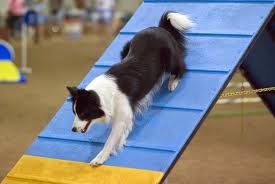
Border Collie on A-Frame must "hit" the yellow area in stride

Stopped Contacts: Stopped contacts, usually a “2 on 2 off” behavior, is when the dog stops at the end of the contact with their two rear feet still on the contact, and their two front feet on the ground. The dog would then be released by the handler before continuing forward. There are many methods to teaching stopped contacts. Some include a nose target, while lots of people will shape the behavior.

Pros to Stopped Contacts:

  • Stopped contacts give the handler a chance to get ahead of their dog.
  • Stopped contacts may not take as much training time and commitment as running contacts.
  • There is no question if the dog has hit the contact or not, because they should be stopped in the contact zone.
  • Sequencing off of the contact can be easier because the handler has a chance to position themselves where they need to be. This also means that the dog can turn off the contact with the handler, they don’t necessarily have to be driving straight.
  • Stopped contacts are an easier position to teach independently.

Cons to Stopped Contacts:
  • Stopped contacts add to your course time, because the dog is stopping, even if just for a brief moment.
  • For environment sensitive dogs, stopped contacts give the dog a chance to look at their surroundings, like the judge standing nearby or the busy situation of a trial, which could lead to the dog getting distracted.
  • Stopped contacts require more impulse control for the dog, because they have to wait to be released. A common problem for high drive or fast dogs is that at competition, they are too amped-up to stop.
German Shepherd would allow board to hit the ground in a stopped contact.
His 2 back feet should be on the yellow board with his 2 front feet on the ground waiting for instruction.

These contact positions can always be modified, depending on what works best for your dog. When choosing one for your dog, think about the following things:
  • Is speed something you are concerned with? Do you mind that stopped contacts will take a few more seconds, or do you want the fast running contacts because you want a better course time?
  • How much time are you willing or able to commit to the training? Our lives can be busy and not everyone has the time or place to train every day or even every week. Figure out what time you can commit. Running contacts take more consistent training and more repetition. If you are only going to class once a week, a stopped contact may be more realistic.
  • Figure out what is best for your dog. Is your dog comfortable enough in the competition environment to stop and wait to be released, or is it best for them to keep moving?
3rd Contact Obstacle known as the dog walk.
 The dog should be hitting the yellow at the end of the board before moving on in the course
Regardless of which performance you choose, you can be successful with either one. We’d love to hear your opinions on the different contact positions, and what works best for you! Comment or e-mail your stories to agility@morrisk9campus.com.