Showing posts with label Tips. Show all posts

Thursday, July 26, 2012

ALLIE'S LAST WEEK OF BOOT CAMP


Allie is in the front of the group during training class eager to learn!

We've heard some wonderful news that there is interest in Allie for adoption! We are all crossing our fingers that she will find her fur-ever home. To continue to further her chances the staff at MK9 wanted to give our reasons why we think Allie is so great:

We love that Allie is so happy to see us when she gets dropped off in the morning, ready for a fun day of training because:
- She loves people she doesn't know unconditionally
- She has a great combination of a sweet manner but playful personality
- She is so affectionate and gentle
- She has joyful puppy-like play especially when she chases tennis balls as if they were bunnies in the grass

"Allie is such a pleasure to work with.." says Morris K9 Campus Trainer Robin Lash. "Most of her success in training is due to that fact that she is such a smart eager-to-please dog!" 

Since Allie might be meeting new dogs as part of her adoption process, we want to show a video of Allie nicely and appropriately greeting another dog. We have loved getting to know her!


If you are interest in adopting Allie, please call 973-664-0865 or visit Eleventh Hour's website for more information about her.


Friday, April 20, 2012

DOES YOUR DOG NEED A BEHAVIOR MODIFICATION PLAN?

Basic training is always helpful. Behaviors like stay, come, settle, and lay down help us to teach our dogs to be great pets. In group training classes, humans learn how to effectively communicate what they want to their dogs. There are some dogs that may need a training program specifically designed for them. A specialized training plan that is built around the needs of the dog and the family that is training him or her is called a behavior modification plan.

When creating a behavior modification plan a certified dog trainer will evaluate what the problem is and why it's happening. It is important to solve what the dog gets out of the unwanted behavior. After answering these questions, and with help, your trainer will make a plan to change the behavior.
A typical behavior modification plan will include:

Management

Exercise and constructive play

Helping the dog's owners to become effective communicators

Instituting a nothing in life is for free program

Teaching the dog appropriate responses

Setting goals for dog and family to meet

If basic training is not enough for your pooch, don't worry and most of all don't give up! Our trainers at Morris K9 Campus know how to work with you and your dog to create a comprehensive behavior modification plan through private lessons. Every dog has the potential to be great dog and we can help you achieve that goal with time, patience, and an awesome behavior modification plan!

Wednesday, November 9, 2011

OFF-LEASH TRAINING


Recall is one of the most important skills a dog can learn. It is absolutely vital to teach your canine companion to come when you call for them. There are many situations you may find yourself in where it is essential and possibly life-saving for your dog to have perfect recall; if the door of your house is left open and Fido bolts, at the park when a squirrel walks by, or if your leash snaps and breaks and there goes your dog! Here are a few, very simple tips to help you perfect your dog’s recall.

 
Tone is Key
If you are in the habit of screaming and yelling your dog’s name whenever you want them to come to you, your anger and raised voice may scare them away. They may associate you with this emotion and that is not a good thing. If you let your dog off-leash in the backyard, your dog has the wonderful opportunity to run around, free and unburdened by the restraint of a leash, sniffing and smelling the world around them. This is indeed a fun and liberating time for your dog. If you call your pup with anger and a loud voice, you are giving Fido no reason to come to you! Your raised voice pales in comparison to playing in the backyard!

Provide a Reason
When you call your dog to come to you, use a firm, but happy voice. Make it clear to your fuzzy friend that you are in a good mood. Provide a little treat, praise and gentle hugs and pats. This will encourage your dog to come to you in the future. If you teach Fido that coming to you will result in loving attention and a treat, why wouldn’t your dog come running? Practice this over and over again in your backyard. Make sure to use small bits of treats or little carrot sticks as a reward so that Fido doesn’t pack on the pounds. Throw in more and more distractions to enforce this skill to the point of perfection.

Why let the fun stop outside? Leave a Kong filled with yummy peanut butter waiting by the door inside or grab your dog's favorite toy and start a quick play session to keep the fun going. This way your dog will be more willing to come inside. The key to great recall is practice and patience. If you keep working with your dog on their recall by using these tips, you will have a dog that wants to return to you time and time again! If this problem continues to plague you, try our training program at Morris K9 Campus and we will help you nail down your recall so that it becomes second nature.

Thursday, November 3, 2011

PUPPIES AND SEPARATION ANXIETY

Separation anxiety can be more difficult to cure in older dogs since it is a learned behavior. Last week we provided some tips to help cure this problem in older or mature dogs even after it has already developed. When it comes to puppies, it is possible to avert this problem altogether. Prevention is key and it is up to you, the pet owner, to ensure your puppy does not develop this behavior later in life. If you have a puppy, here are some steps you can take to prevent this issue from developing.

Alone Time
Though this may be extremely difficult, like resisting free samples of chocolate, it is important to limit the amount of time you spend with your puppy. It is not necessary to be by your puppy’s side 24/7. When your puppy is sleeping, let him or her be, don’t hover. If you need to clean your basement, do it. If you need to buy more milk, run out to the store. You don’t need to call a puppy sitter to come for a half-hour or an hour. Leave your pup periodically and they will adjust to this alone time in no time!

Create a Comfy Nook
Again, it is vital to designate an area for your puppy while you are gone. It can be the laundry room, the kitchen or a crate. This will ensure your puppy does not soil the fancy Persian rug or start chewing on sockets and wires as though they were rawhide. Deck your puppy playroom with comfy blankets, toys and a treat or two! Have your puppy spend time in this designated area when you are home as well, so that he or she can adjust to it and not associate the crate with your absence.

Condition
As soon as you get a puppy, it is crucial to acclimate him or her to alone time. This takes a certain amount of conditioning that goes as follows: Put your puppy in their crate and sit close by in the room with them. Read a book or spend time on your laptop. Ignore your puppy if she or he gets anxious, squirms, or tries to get out of the puppy playroom. Praise your pup with sweet words, a treat, and attention when calm. After a while, move back further and continue the same thing; praise for calm behavior, the cold shoulder for fussing. Continue until you are able to move about the room without your puppy creating a scene. After an hour, give your pup a potty break. Next, leave the room. Enter when you pup is settled. Increase the amount of time you are out of the room from five minutes to 10 minutes to 15 minutes and so on. This will show your playful pup that you will return. Progress with this routine until you can step outside the house and even hop in the car and drive around the block or to the local supermarket. Take it slowly and don’t jump ahead until your puppy gets used to each step of the conditioning process and no longer creates a commotion. If you follow these steps your puppy will develop into a confident, self-assured dog that understands when you leave, you will always return to them.

Friday, October 7, 2011

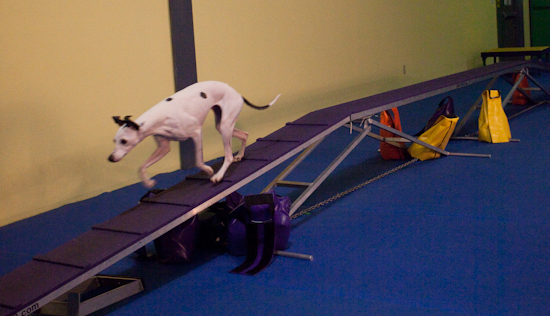
AGILITY OBSTACLES

Photo Courtesy of Dave Hamster
In our effort to demystify the canine sport of agility, this week we will explain the different obstacles used in agility courses. The obstacles used in each course can vary depending on the venue holding the trial whether its NADAC, USDAA, or AKC.

Contact Obstacles
Contact obstacles must be touched by the dog, especially the ending portion of the obstacle. This section of the obstacle is generally painted a bright color like yellow or orange. The reason these sections of the obstacle must be touched or walked on by the dog is for safety reasons. If your dog is on the pyramid shaped A-frame (which we will discuss) and wants to jump from the top of the pyramid, he or she could get injured. Requiring the dog to touch the bottom most section of the pyramid ensures that your dog will safely jog off the obstacle. Not doing so can result in a fault which will take points off your agility trial score.

A-Frame: The A-Frame consists of two wide planks that create a pyramid-like structure. Your dog must run up one side and down the other, making sure to touch the painted lower half.

Dog Walk: The dog walk is generally one foot wide and five feet high. There is an ascending plank, a horizontal plank, and a descending plank that your dog must navigate. This requires a level of balance. Your dog must touch the yellow painted contact zones.

Seesaw/Teeter: This obstacle can be scary for some dogs because it can feel like they are not in control of the equipment they are walking on. Once they adjust to the motion and how their weight affects the movement of the seesaw, dogs can confront the challenge with ease. Just make sure your dog touches the yellow section in the middle of the seesaw!

Pause Table: A pause table is a wide, low elevated table that your dog needs to jump on and literally pause. Some venues want the dog to lay down for five seconds, others simply want your canine to stay still on all fours.

Non-Contact Obstacles: 
Weave Poles: These are upright vertical poles that your dog must weave in and out of. This can be one of the most fun obstacles to watch a dog navigate!

Tunnels: A fabric or plastic tunnel your dog must run through. Tunnels can be straight or curved.

Chute: A short tunnel with a  fabric extension. While your dog is running through, there is a section where your dog cannot see you.

Tire: A circular tire for your dog to jump through.


Photo Courtesy of Lil Sheperd
 Jumps: There are many types of jumps.  Some jumps have one bar and the height of  bar can be set at different heights which is all up to the dog organizations' discretion. Other jumps have more depth and can be double or even triple jumps. Broad Jumps are low and on the ground but wide and situated as though your dog were jumping over a stream. Jumps with Wings have extensions on the end that keeps you, the handler, further away from your dog, thus testing your distance communication.

Thursday, August 25, 2011

TINKLE TINKLE LITTLE CANINE

Photo Courtesy of Rochelle, just rochelle
For most of us, coming home to our dogs or picking them up from daycare can be the highlight of our day! The tail wag, the goofy grin and joyous licks, the wiggling body, and for some of us…a little tinkle. While we can appreciate and share their happiness concerning our return, cleaning up their yellow puddle is not quite the salutation we hope for. Some dogs pee out of excitement. We are accustomed to puppies with this issue but some adult dogs seem to maintain this behavior. When they do, it is known as “adult excitement urination.” While this can be associated with greeting new people or saying hello to their owner, this reaction can also happen when bringing their leash and collar out, grabbing their favorite toy, or getting in the car to go to the park. Whatever the cause for their excitement urination, rest assured that there are some simple solutions to help your adult dog overcome this method of expressing their happiness and anticipation.

Play Detective
Determine the cause that makes Fido urinate every time. Is it when you reach for the leash, is it the high-pitched voice you use to greet your dog when you come home? Once you have concluded the reason that makes your pooch pee, work on addressing that issue.

Change it Up
Now that you have isolated the reason that makes your dog squat and tinkle, work on fixing your behavior, yes yours. If you enter the house squealing and saying your dog’s name over and over again, it will only excite your dog who will sense the rising happiness in your voice. Tone it down for your dog’s sake and though it may be difficult, ignore your dog for the first 10 minutes after you walk in the door. Tell guests to do the same by not petting, talking, or even making eye contact with your dog. When your dog is calm, reward that behavior by petting your dog and praise him or her calmly. If your dog pees whenever you bring out the leash, let your dog outside first, and then put their leash on. If your canine leaves a puddle in the car, take your dog for a short walk before taking him or her on the road.

Confidence Boost
Since adult excitement urination can sometimes be related to your dog’s insecurity, it is very important to work on building your dog’s self-confidence. Teach your dog new tricks and reward with treats and praise. Try agility at Morris K9 Campus, a wonderful physical and mental outlet that has a great track record for improving dogs’ confidence levels. Bring fulfillment to your canine’s life by exercising him or her. Take your dog on long walks, work your pooch out on the canine treadmill at Morris K9 Campus, and socialize Fido by engaging with other fuzzy friends. If your dog is up to date with vaccinations and has a good temperament with other people and dogs, try Doggie Daycare. If you are unsure how your dog will react with other wet-nosed pals, fear not! Morris K9 Campus offers a free half day evaluation to observe how well your dog plays with others, so try it out!

All dogs express their excitement in different ways. Some adult dogs continue this behavior. However, if you determine the root cause that leads to your dog’s yellow puddle, you can slowly work on eradicating this issue by adjusting your own behavior, desensitizing your dog, and by ensuring your pet is mentally and physically satisfied.

Friday, August 12, 2011

PET PROOF YOUR HOUSE

By now, as a responsible pet parent, you know there are some basic foods you shouldn’t feed your canine because they are toxic to your dog’s digestive system like grapes, raisins, chocolate, and onions to name a few. But what about non-edible substances that Fido can’t seem to resist crunching on? You would think every item in your house had been doused in chicken scented perfume by your canine’s enthusiasm for objects ranging from socks to your child’s Barbie dolls. Though all dogs are capable of this behavior, Lab owners and puppy parents are far too familiar with this scenario. What can you do to prevent this curious and potentially hazardous habit?

Anticipation
Just as you baby-proof a house when you are expecting, it is crucial to dog-proof your house as well, especially if you have a puppy or a dog that is prone to nibbling foreign objects. If it’s easily accessible, your dog will find it. If you leave your nice leather shoes lying on the living room floor, chances are Fido will find it and view it as a chewy appetizer. Look over all the rooms you allow your dog in and view them as though you were wearing special K9 goggles. Notice objects lying around that are easy to get at and what could cause a potential hazard to your dog if eaten or swallowed. If you have kids, don’t allow them to leave their toys and playthings on the floor. Teach your children to pick up after themselves while simultaneously keeping your dog safe.

Engage
A bored dog can be a mischievous dog who will likely engage in unfavorable activities. These activities can include chewing household objects whether edible or not. Keep your dog happy and busy. Provide rubbery chew toys for your canine to nibble on that are large enough so that they can't be swallowed. Make sure to take time out of your day to play with your pup. Daily walks and exercise sessions are a perfect outlet for your dog. If your time is limited, simply drop your dog off at Morris K9 Campus for daycare and a day of fun and play. Register your dog for a treadmill session while at daycare for extra exercise and attention. Training will challenge your dog and provide him or her with mental stimulation. Morris K9 Campus offers training classes through a membership program that allows you to choose your schedule and move through the various levels at your own speed.
How Much Will It Cost?
If you’ve ever wondered what the cost of removing certain objects from your pet’s stomach would be based on the item, the American Kennel Club pet healthcare provider, Pet Partners Inc. has outlined the price of such expenditures. The following is a list of some of the objects dogs have eaten and the removal cost of each.                                                     

Toy $669                                                   

Sock $1,173

Snail Bait $146

Golf Balls $1,844

Dental Floss $3,590

Sources: Wyn and Mary Baruch, Ph.D Citizen Canine

What unusual objects has your dog eaten?

Thursday, August 4, 2011

STEPS FOR INTRODUCING YOUR FURBABY TO YOUR NEWBORN

Photo Courtesy of smoorenburg
Are you concerned about introducing a baby into your dog-friendly household? Has your pet become protective or clingy with an expectant mother? Read on for 5 simple tips to make this transition an easy one.

1. Allow your dog to investigate the nursery once it is all set up. Make it clear that this is not your pet’s room and it is off limits unless he or she is invited. Spend some time in the nursery alone to let your pet know that you will be spending time in the room without them.

Photo Courtesy of Lunchbox
2. If your dog has any behavior issues that could be a problem with a new baby, now is certainly the time to train your canine. No matter the age of your dog, bring him or her to Morris K9 Campus for all your basic training needs. Sign up for our Levels Training Membership to get started.  This is the time when you really want your dog consistently obeying your commands.

2. Begin playing a recording of baby noises around the house (particularly in the nursery), and reassure your pet that these sounds are safe and normal. When the sound of a baby crying happens in the recording, spend some time in the nursery. After a little while, turn down the volume so your pet understands the crying will eventually stop.

3. Bring home the baby’s cap or blanket from the hospital before the baby arrives. These items have both the baby’s scent as well as yours and are best preserved if kept in a sealed bag. Have your dog sit and smell the item and give your dog a treat every time your dog sits and sniffs the baby’s scent.  Your dog will recognize the scent as something positive.

4. When mother and baby return home from the hospital, put the dog outside or in another room. Since your pet has not seen Mom in a few days, he or she could be very excitable. Once the baby is safely in the nursery, mom should spend some time with the pet so they can reacquaint themselves.

Photo Courtesy of nateone
5. Introduce a new baby to your pet(s) about a day after he or she arrives home. This will give your pet a chance to hear the baby’s sounds. Let your pet sniff the baby’s blanket first, NOT the baby’s face. Pay attention to your pet…if the pet is unsure, try again another day. If things seem to be going well, you can allow your pet to continue to smell the baby’s hands and finally, face. It may take a little while, but your pet will get used to your new addition.

Obviously, the most important thing to remember about introducing a pet to a newborn is to always be aware of the pet’s body language and behavior. An adult must be present at all times, as a baby has no defense mechanisms or ways of communicating with your pet. With some patience and careful guidance, your new baby and your pet will become lifelong pals.

Wednesday, May 18, 2011

It's Bite Prevention Week! Know the Signs!

As we mentioned in our previous blog post, this week from May 15-21 is Bite Prevention Week. This initiative was created by the non-profit organization Doggone Safe whose mission is dog bite prevention through education. Their goal is to not only protect children from dog bites that could have been prevented by knowing dog body language, but to also save dogs from being uselessly euthanized or sent to a shelter. Since we cannot strike up an easy conversational rapport with the canine member of our family, we must rely on more subtle signs of communication that consist of dog body language. Learning to read what your dog and other dogs are feeling is the key to safety. In honor of Bite Prevention Week, we are elaborating on canine body language.

Watch Out!
-Tail between the legs
-Ears back
-Whites of the eyes showing
-Teeth bared
-Head down
-Excessive yawning or licking
-Tense furrowed brow
Situations to Avoid
-Do not approach a dog that is eating or chewing a bone
-Adhere to the old adage, let sleeping dogs lie. Never interrupt a slumbering dog.
-Do not force a dog into a submissive position.
-Do not approach a dog that is tethered

Be My Pal!
-Tail wagging
-Relaxed expression
-Tongue out, mouth open

Doggonesafe has made an informative video illustrating these important canine cues.


Dogs may not be able to tap you on the shoulder and say, “Hey, I’m scared!” or “Hey, I’m annoyed right now!” but their body exhibits these signs in numerous ways. Subtle though it is, we would all benefit from tuning our radar to these important canine signals.

Friday, April 15, 2011

How to Adjust Your Puppy to Alone Time

Is there anything more irresistible in life than a warm, fuzzy, sweet puppy? Squirmy, playful, and innocent as a newborn there’s no better way to pass the time than to watch a puppy play, jump, sleep, breathe…just about anything! We understand the difficulty of actually getting up off the floor and leaving your puppy’s side to brush your teeth let alone leave the house. That said, we also understand alone time is a pivotal step in a puppy’s maturation process and crucial to healthy development. In order to prevent separation anxiety down the line for both you and your pet, we have outlined some baby steps and tips to help you confront the issue with minimal effort.

But Wait! Before you begin, make sure that your baby dog has had a recent potty break and some food in the ole’ belly so that if puppy starts whining, you know it’s not for those reasons.

Puppy Play
Engaging your precious little pal in games and activities that work both their expanding minds and muscles is just as essential to their overall well-being as food and bathroom breaks. If you don’t want your pooch to be upset, you need to provide them with an outlet. Romp in the yard, play fetch, try training techniques like Morris K9 Campus’s puppy on-off leash class; all activities that get your puppy’s body moving and their brain thinking. If you provide this activity before leaving, they will be exhausted and less likely to be upset. If you engage your puppy after you’ve been away it proves you will return and a reward is on the way. It’s a win-win!

Photo courtesy of Barely Fitz
The Crate is Your Best Friend!
Andrea Arden, animal behavior counselor and pet expert suggests taking advantage of your growing pup’s need for ample rest time by adjusting your dog to sleeping in a crate. In the beginning, keep the crate close to you or other family members. Gradually move the crate further and further away over the course of a few weeks. Need to get some chores done around the house? Want to try that new workout DVD? Place puppy in the crate and tackle your to-do list with vigor! Your puppy will probably whine which is normal in the beginning. Simply listen to music or turn up the volume on your workout DVD. Don’t forget, you also deserve your own attention as well! After 30 minutes to an hour, let your pooch out. This demonstrates to your dog that after a certain extent of time, you will return, which will ease their little minds.
Note: Baby gates placed in designated areas can often be just as useful.

Toyland
Photo courtesy of Bowi the Boxer
When life calls and you must leave, toys can take your place amazingly well! Just make sure they are safe toys that won’t cause a choking hazard (for more information read our blog article The Hunt for the Best Dog Toy). Kongs® filled with treats can be appetizing and engaging and chew toys can aid in the teething process.

We understand that raising a puppy is both a joyously wonderful experience as well as a little overwhelming. If you follow these tips both you and your puppy will be better for it. If you need more assistance raising your puppy, Morris K9 Campus is standing by and eagerly waiting to lend a paw.

Friday, March 11, 2011

Jump for Joy: A Solution for Dog Jumping

We know our dogs love us as much as we love them. One of the ways dogs express their emotion for us and others is by greeting us enthusiastically--tail wagging, wet kisses, and over abundance of happiness that can include jumping. Unfortunately jumping on us, or worse our guests, can be an irritating problem. 

Here are some tips to nip that bad habit in the bud so you and your dog can enjoy your time together:

The Turn Around Approach
 When you arrive home, as soon as your dog jumps on you, turn away. Keep turning away from your dog if she continues to follow and jump on you, until she stops.

The Cold Shoulder
Give your dog the cold shoulder when you return home and ignore her for 5 minutes. This might be difficult but if you make a scene when you arrive, your dog will only become extremely excited and be more likely to jump on you. The less of an ordeal you make your arrivals and departures, the less your dog will make of them.

The Sit Approach
The second your dog jumps on you, tell her, “Sit” or “Down” and shower her with praise and love or a small treat as soon as she complies.

The Leash Method
Keep your dog on a leash when you get home and have her sit. If she jumps up, pull her leash taught so she can’t jump and is forced to sit. Praise her when she sits.

Toy Time
Throw your fuzzy friend a toy or her favorite bone when you enter the house to entertain her and keep her distracted from the temptation of jumping.

Once you have found an approach that works for you and your dog, you can request that your guests  reinforce this approach to help your dog become a well behaved companion in all situations. 

Which approach works for you?

Source: wholedogjournal.com

Thursday, January 27, 2011

The Canine Meet and Greet

The reason why dogs typically have trouble meeting new people is that they didn't have enough positive experiences with a variety of unfamiliar people during puppyhood. From three weeks to three months of age, puppies are most receptive to forming bonds. If they meet a variety of people and have positive experiences, they believe that all people will treat them well. Dogs who don’t receive the type and number of experiences they need often end up being fearful of some or all unfamiliar people.

Fortunately, Morris K9 Campus provides plenty of opportunities to socialize dogs--our Levels Training Program, Daycare and social events that incorporate a variety of dogs and people. But just in case your dog or someone else's hasn't be properly socialized, here are some tips for a doggie meet and greet.

How We Make It Worse
People can unintentionally make the situation worse by forgetting to let a dog approach them rather than barging into their space. In this case, some dogs will freeze or shrink, pretending it's a bad dream, while others bark or growl. A sweet, slightly insecure dog can quickly turn into a defensive, growling one at the least convenient moment.

Some owners respond to this behavior by reprimanding or punishing their dog, but this just teaches him to hide his fear from you. As a result, your dog might repress his barks and growls until he reaches his breaking point, resulting in a bite.

Why Are Dogs Afraid of Me?
Many of us can’t understand why dogs are afraid of people who are making friendly human gestures. But try to think of things from a dog’s perspective. Imagine your child is afraid of dogs and a friend allows their dog to bound right into your child’s face. Telling your child the dog is friendly isn’t likely to make her feel any better. Instead, your child would appreciate being able to greet the dog on her own terms. 

So how should we meet a dog? Stand straight up or crouch down on one knee while looking slightly away so the dog can approach and sniff you at his own pace. You can speed up the friendship if you drop some tasty treats close to where you’re standing. If the dog takes the treats without any hesitation, you can try holding the treats in your hand for him to take.

The trick to ensuring that you don't frighten a dog even after an initial positive greeting is to gradually get him used to you in different positions. Avoid leaning over him, reaching over his head or grabbing and hugging him. Instead move slowly and smoothly in order to give him a chance to back away.

What Is the Dog Telling Me?
Often the biggest mistake we make in meeting a dog is failing to recognizing body language. For example, a dog may be tense with eyes darting back and forth or looking away while he's cowering. Yawning, licking lips, panting, moving in slow motion, moving ears down or to the sides, tail between his legs or a furrowed brow are all signs that the dog is stressed or anxious. If you see any of these signs in a dog, quickly move away so he's out of range. The goal is to change the dog’s emotional state from scared to happy so that he can eventually learn to associate unfamiliar people with good things

A Happy Ending
The body language you want to see when greeting a dog includes relaxed posture and a steady, soft gaze. His tail should either wag or hang loosely down. The experience should seem very familiar to the dog and be fun and pleasant for you! 

If your dog is struggling with meeting new people or dogs, give us a call. We'd be happy to work with both of you to make meeting new friends a positive experience.

Source: www.dogster.com

Wednesday, July 21, 2010

Puppy Pointers

If you're a new puppy owner, you know that it can be trying at times to remain calm. We have a few creative suggestions for helping you to keep your sanity while overseeing your puppy's growth and development.

Frosty Formula
If your puppy is teething, try freezing a wet washcloth for him to chew on. The cold cloth will soothe his gums. Just be sure to supervise your puppy so he doesn't chew up and swallow any pieces of the washcloth!


Chopstick Challenge
Have any leftover takeout chop sticks?  Try cutting them with a pair of scissors. This is very similar to the sound a dog hears when he gets his nails trimmed. Acclimate your dog to the sound by rewarding him with a treat every time you make a cut to the chopstick. When you are ready to try his actual nails, go slowly. He may only allow you to trim the nails on one foot first. Just try the other foot a few hours later, or when the puppy is sleeping after a long walk. Eventually you will be able to get them all in one fell swoop! (Or, you could bring him in to us for a quick and efficient trim. We'd be happy to help!) 

For the rest of our tricks, please join us at any of our puppy offerings.