Showing posts with label Terminology. Show all posts

Friday, October 7, 2011

AGILITY OBSTACLES

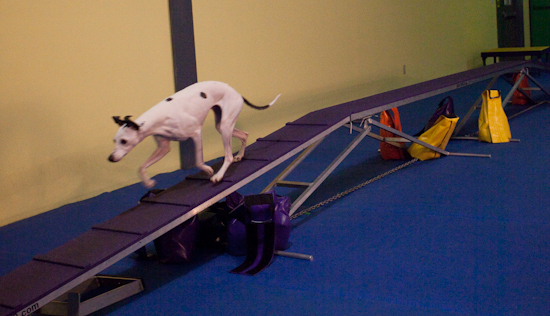
Photo Courtesy of Dave Hamster
In our effort to demystify the canine sport of agility, this week we will explain the different obstacles used in agility courses. The obstacles used in each course can vary depending on the venue holding the trial whether its NADAC, USDAA, or AKC.

Contact Obstacles
Contact obstacles must be touched by the dog, especially the ending portion of the obstacle. This section of the obstacle is generally painted a bright color like yellow or orange. The reason these sections of the obstacle must be touched or walked on by the dog is for safety reasons. If your dog is on the pyramid shaped A-frame (which we will discuss) and wants to jump from the top of the pyramid, he or she could get injured. Requiring the dog to touch the bottom most section of the pyramid ensures that your dog will safely jog off the obstacle. Not doing so can result in a fault which will take points off your agility trial score.

A-Frame: The A-Frame consists of two wide planks that create a pyramid-like structure. Your dog must run up one side and down the other, making sure to touch the painted lower half.

Dog Walk: The dog walk is generally one foot wide and five feet high. There is an ascending plank, a horizontal plank, and a descending plank that your dog must navigate. This requires a level of balance. Your dog must touch the yellow painted contact zones.

Seesaw/Teeter: This obstacle can be scary for some dogs because it can feel like they are not in control of the equipment they are walking on. Once they adjust to the motion and how their weight affects the movement of the seesaw, dogs can confront the challenge with ease. Just make sure your dog touches the yellow section in the middle of the seesaw!

Pause Table: A pause table is a wide, low elevated table that your dog needs to jump on and literally pause. Some venues want the dog to lay down for five seconds, others simply want your canine to stay still on all fours.

Non-Contact Obstacles: 
Weave Poles: These are upright vertical poles that your dog must weave in and out of. This can be one of the most fun obstacles to watch a dog navigate!

Tunnels: A fabric or plastic tunnel your dog must run through. Tunnels can be straight or curved.

Chute: A short tunnel with a  fabric extension. While your dog is running through, there is a section where your dog cannot see you.

Tire: A circular tire for your dog to jump through.


Photo Courtesy of Lil Sheperd
 Jumps: There are many types of jumps.  Some jumps have one bar and the height of  bar can be set at different heights which is all up to the dog organizations' discretion. Other jumps have more depth and can be double or even triple jumps. Broad Jumps are low and on the ground but wide and situated as though your dog were jumping over a stream. Jumps with Wings have extensions on the end that keeps you, the handler, further away from your dog, thus testing your distance communication.

Wednesday, September 28, 2011

THE AGILITY RULE MAKERS AND REGULATORS

Photo Courtesy of mister b 1138
The canine sport of dog agility is a world unto itself. Last week, we touched on some of its strange and somewhat confusing vocabulary. This week we reveal the dog clubs/organizations in the United States that regulate and set rules for agility trials. Each dog organization offers its own version of the standard agility course. The titles you can win differ depending on the organization. For example, if you compete and win a top title in an American Kennel Club (AKC) agility trial, you must still start at level one if you decide to compete in a United States Dog Agility Association (USDAA) trial. The following organizations sponsor dog agility trials in the U.S.

AKC
The AKC stands for the American Kennel Club which dates back to 1884. As a highly acclaimed and well recognized dog organization, the American Kennel Club is one of the largest registries of purebred dogs in the world. They focus on promoting and sanctioning events for purebred dogs, thus their agility trials are for purebred and companion dogs that have registered with the AKC only. Their courses are smaller than the United States Dog Agility Association's (USDAA) and their obstacles are less difficult to navigate than the USDAA’s agility obstacles.

USDAA
The USDAA stands for the United States Dog Agility Association, Inc , formed in 1986. The organization was created using British standards including equipment used and the rules and regulations for the standard agility course. It also introduced non-standard classes like Jumpers, Gamblers, Snooker, and the Relay. The USDAA is responsible for the following agility tournaments: USDAA's Grand Prix of Dog Agility® World Championships, now in its 17th year, the $10,000 Dog Agility Steeplechase®, and the Dog Agility Masters® Three-Dog Team Championship. These trials tend to be more difficult with narrower planks, higher jumps and larger courses. More emphasis is placed on speed in these trials. The USDAA provides trials for purebred as well as mixed breed dogs. This organization decided to do away with the single ribbon system and devised an agility title system where handlers and their dogs earn points towards different titles. This concept is now extremely popular in the world of dog agility.

CPE
CPE stands for Canine Performance Events, Inc, a national dog agility association in the US. It allows both purebreeds and mixed breeds to compete in various agility trials. CPE agility trials are similar in style to those sanctioned by the AKC. This association emphasizes fun while trialing and offers many games as classes like Jumpers and Snooker.

Photo Courtesy of mister b 1138
NADAC
This organization, known as the North American Dog Agility Council, made a bold move by moving away from international standards of dog agility in order to create its own version of a faster, yet safer agility course with less obstacles and lower jump heights. Both mixed breeds and purebred dogs are permitted to compete in the agility trials.

UKC
The United Kennel Club (UKC) formed in 1898 as another purebred dog registry. However, the UKC is different from the AKC because it primarily focuses on working breed dogs and recognizes them for their working abilities in addition to how well they meet their breed’s standards. However, the UKC allows mixed breed dogs to register under the Limited Privilege category which permits them to participate in UKC dog obedience and agility events. They generally have smaller, more contained courses that require more precision.

UK Agility International (UKI)
Existing since 2004 in Great Britain as UK Agility, this organization was urged to spread to North America. They changed the name to UK Agility International and now offer many agility competitions in the U.S and Canada. The organization was formed by a husband and wife team.


Sources: Affordable Agility