Showing posts with label Off Leash. Show all posts

Friday, November 29, 2013

Do dogs age out of daycare?


It all starts with an adorable puppy. You decide to bring them to a dog daycare facility, and they love it! They enjoy playing with the other dogs, are always eager to get there and come home tired but happy. You continue to bring your dog to daycare as they age and grow, but is there a point where your dog may “age out” of the daycare environment?
Daycare should be an overall fun and rewarding experience for your dog. The question many clients ask is, when does daycare stop being fun for an older dog? It’s important to remember the structure of daycare as a whole, that your dog is given time to play in a room with other dogs. When your dog is a puppy or youthful adolescent, they want to play with everyone. The idea of having so many other dogs to play with excites them. At this point, new dogs mean new playmates and they love and crave time spent in their company. However, as your dog grows from a puppy to an adult dog, things can slowly begin to change.
As they age, your dog might still love playing with other dogs, but daycare can start to get slightly overwhelming. Your mature adult dog is now in a room with energetic youths who are looking to bounce around and play for hours. While your adult dog might enjoy being there, countless hours with rambunctious younger playmates can become overwhelming and not as fun as it use to be.
Picture it this way: to us, adult dogs playing with adolescent dogs would be equivalent to a 35 year old being invited to a 15 year old’s birthday party. According to WebMD Pets, a one-year-old dog is about 15 in human years and a four-year-old dog is about 36. In that time period, like us, dogs mature and start to play differently. 

The Dog Guru’s Susan Briggs and Robin Bennett recently published an article called “Ask the Experts – Is my dog happy in off-leash play?”, where they address the issue of age in daycare dogs. They say, “Generally speaking, dogs over 5-6 years of age will have a shorter tolerance level for off leash play with other dogs. This is true even if your dog grew up playing in dog parks and attending daycare. This doesn’t mean that older dogs shouldn’t play off leash with other dogs, but it does mean that shorter periods of play may be more fun for your older dog. If your dog (of any age) attends a dog daycare, make sure he gets some down time where other dogs allow him to rest or he is separated so he can sleep.”
It is important to remember that dogs do change as they get older. It is normal for you or staff at a dog daycare to notice a change in your dog’s behavior as they age. If daycare staff informs you that they have noticed a difference in your dog’s behavior, it should not be cause for concern. Instead, listen to what they have to say. They have your pet’s best interests in mind! Maybe your pet isn’t enjoying daycare like they used to, or the environment seems like too much for them. This does not mean that they dislike playing with other dogs, (they probably still love it!) but it does mean that your dog may be ready for a different environment.
At Morris K9 Campus, our goal is to make daycare a fun and engaging environment for all of our pets. Our visitors are all given down time to rest between play sessions, but for those aging pets who might prefer a lower key environment, our sister company Morris Animal Inn offers private daycare dedicated to personal one-on-one play. Each dog receives play sessions with a person, who can cater their playtime to whatever activities they like best. This could be a suitable alternative if your dog begins to tire of the daycare environment but you still need a place for them to visit.
If you get to a point when your dog’s daycare facility no longer recommends daycare for your older dog, remember that this is normal. Not every dog will like this type of play forever, and every dog will be different. Some older dogs can still enjoy their time in daycare. It’s up to you and your daycare to devise a plan that would work best for your older dog.

Tuesday, August 21, 2012

Recognizing Recall


PLAY AND TRAIN AT MORRIS K9 CAMPUS!

Our Play and Train program is designed so that your dog can play the day away while learning new commands and training skills. The only requirement is that your dog has been approved for daycare! Two of our most popular Play and Train skills are loose leash walking and "come" (getting the dog to recall).


Cleo and Lauren attention and focus.
 
LOOSE LEASH

There are many important steps that lead to having a dog with good leash skills. First, you want your dog's attention and focus to be on you. In order to accomplish this there are games you can play with your dog, such as name game. All it entails is you getting your dog's attention with the food and saying his/her name as the food follows from your eye line to your dogs.


Cleo and Lauren loose leash walking.


Next, you want to teach your dog where to walk. You cannot get upset for having a dog that doesn't walk properly if you have never showed them the right way to do it. In order to do this, pick which side (left or right) you would like your dog to walk on. Always practice walking with your dog on that side.


"COME"

"Come" is the most important thing you can teach your dog. It is literally a life saver. When teaching "come" you want to make sure your dog is always successful. This means starting off easy. You always want to use an enthusiastic tone! Your dog is not going to want to come to you if you are using the same voice as when he/she gets in trouble. You have to be more exciting than whatever it is you are calling your dog away from.


 Jack has a great recall in group, this is an advanced skill! 


To inquire more about Play and Train, please call 973.252.5100 or visit our website.  If your dog does not prefer the company of other dogs we offer an alternative Train and Fitness program!

Find us on Facebook: Morris K9 Campus!


Wednesday, March 14, 2012

SAFE-PROOF YOUR YARD FOR FIDO

Spring is right around the corner which means you are probably readying your yard for the coming months so that you can enjoy a lush, verdant lawn and vibrant colorful flowers! Your yard is your own beautiful slice of nature that you can landscape and grow how you like. As you prepare your yard for warmer weather, keep in mind the following tips so that your yard is not only visually appealing but also safe for the furriest member of your family.

Fence In Your Yard
Dogs are natural born explorers with little regard for a map or compass, relying solely on their olfactory senses and stellar hearing capabilities. They can hear and smell interesting stimuli that are outside the perimeter of your yard. Unfortunately, these senses may not always be enough to lead them back to home sweet home. Because there is nothing more upsetting than a lost dog, it is highly important your yard is fully fenced in to prevent this from happening. If your dog is a jumper or a large breed dog, make sure to install a tall fence that is sturdy, strong, and can resist the repeated pressure of your dog jumping against it. If your dog likes to dig, it is crucial to reinforce the fence in order to deter your pooch from recreating a scene out of The Great Escape and tunneling to the other side. Make sure the fence is placed deep in the ground so this scenario cannot happen. Do not place objects like garbage cans near a fence that your canine can jump on and use as a trampoline to hop over the fence. Remember, if you are an owner that leaves your dog chained to a tree in the yard, it is not the safest option if you are not there to monitor and there is no fence. The rope or chain can easily break and your dog can get loose.
Lawn Maintenance
Before applying fertilizers, herbicides, or insecticides, remove any water bowls or dog toys from the yard. Wait until chemicals have completely dried up before returning them to the yard. Some sources suggest waiting up to four days before allowing your dog to go out in the yard. Consider applying the chemicals in shifts and monitor your pup when outside to ensure he or she steers clear of the infected area for the suggested time frame. Keep chemicals in its original packaging and store them in a spot your pet cannot access. According to the ASPCA Poison Control Center, cocoa mulch, if heavily ingested, can have a similar effect on dogs as chocolate causing vomiting and diarrhea, so steer clear of this mulch. The most poisonous pesticides for dogs are slug and snail bait, gopher and rat poison, fly bait and systemic insecticides. For the safety of your precious pooch, it is best to invest in natural, organic, and chemical-free lawn substances to avoid this situation all together.

Holes
The potholes that continue to plague your driveway every year after winter may make you crazy but turn your attention to the divets and holes dotting your grassy yard as well. If your dog takes off after a squirrel or rabbit and their paw happens to land in a hole, your pooch is liable to strain a muscle or sprain an ankle. Patch up holes with topsoil and replant grass in these areas. Enlist the help of a landscaper if lawn maintenance is not your specialty. 
Letting your dog out in the backyard should be an easy way for your pooch to enjoy the outdoors. If you follow these simple steps to safeguard your yard for Fido, it can be a walk in the park.

Wednesday, November 9, 2011

OFF-LEASH TRAINING


Recall is one of the most important skills a dog can learn. It is absolutely vital to teach your canine companion to come when you call for them. There are many situations you may find yourself in where it is essential and possibly life-saving for your dog to have perfect recall; if the door of your house is left open and Fido bolts, at the park when a squirrel walks by, or if your leash snaps and breaks and there goes your dog! Here are a few, very simple tips to help you perfect your dog’s recall.

 
Tone is Key
If you are in the habit of screaming and yelling your dog’s name whenever you want them to come to you, your anger and raised voice may scare them away. They may associate you with this emotion and that is not a good thing. If you let your dog off-leash in the backyard, your dog has the wonderful opportunity to run around, free and unburdened by the restraint of a leash, sniffing and smelling the world around them. This is indeed a fun and liberating time for your dog. If you call your pup with anger and a loud voice, you are giving Fido no reason to come to you! Your raised voice pales in comparison to playing in the backyard!

Provide a Reason
When you call your dog to come to you, use a firm, but happy voice. Make it clear to your fuzzy friend that you are in a good mood. Provide a little treat, praise and gentle hugs and pats. This will encourage your dog to come to you in the future. If you teach Fido that coming to you will result in loving attention and a treat, why wouldn’t your dog come running? Practice this over and over again in your backyard. Make sure to use small bits of treats or little carrot sticks as a reward so that Fido doesn’t pack on the pounds. Throw in more and more distractions to enforce this skill to the point of perfection.

Why let the fun stop outside? Leave a Kong filled with yummy peanut butter waiting by the door inside or grab your dog's favorite toy and start a quick play session to keep the fun going. This way your dog will be more willing to come inside. The key to great recall is practice and patience. If you keep working with your dog on their recall by using these tips, you will have a dog that wants to return to you time and time again! If this problem continues to plague you, try our training program at Morris K9 Campus and we will help you nail down your recall so that it becomes second nature.

Friday, October 7, 2011

AGILITY OBSTACLES

Photo Courtesy of Dave Hamster
In our effort to demystify the canine sport of agility, this week we will explain the different obstacles used in agility courses. The obstacles used in each course can vary depending on the venue holding the trial whether its NADAC, USDAA, or AKC.

Contact Obstacles
Contact obstacles must be touched by the dog, especially the ending portion of the obstacle. This section of the obstacle is generally painted a bright color like yellow or orange. The reason these sections of the obstacle must be touched or walked on by the dog is for safety reasons. If your dog is on the pyramid shaped A-frame (which we will discuss) and wants to jump from the top of the pyramid, he or she could get injured. Requiring the dog to touch the bottom most section of the pyramid ensures that your dog will safely jog off the obstacle. Not doing so can result in a fault which will take points off your agility trial score.

A-Frame: The A-Frame consists of two wide planks that create a pyramid-like structure. Your dog must run up one side and down the other, making sure to touch the painted lower half.

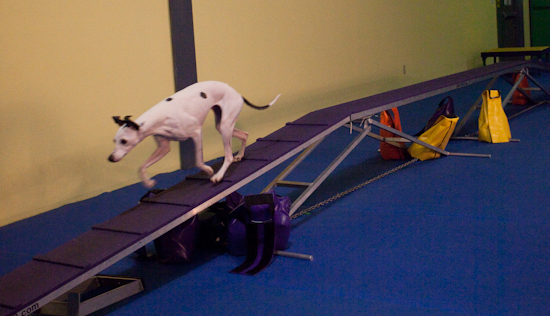
Dog Walk: The dog walk is generally one foot wide and five feet high. There is an ascending plank, a horizontal plank, and a descending plank that your dog must navigate. This requires a level of balance. Your dog must touch the yellow painted contact zones.

Seesaw/Teeter: This obstacle can be scary for some dogs because it can feel like they are not in control of the equipment they are walking on. Once they adjust to the motion and how their weight affects the movement of the seesaw, dogs can confront the challenge with ease. Just make sure your dog touches the yellow section in the middle of the seesaw!

Pause Table: A pause table is a wide, low elevated table that your dog needs to jump on and literally pause. Some venues want the dog to lay down for five seconds, others simply want your canine to stay still on all fours.

Non-Contact Obstacles: 
Weave Poles: These are upright vertical poles that your dog must weave in and out of. This can be one of the most fun obstacles to watch a dog navigate!

Tunnels: A fabric or plastic tunnel your dog must run through. Tunnels can be straight or curved.

Chute: A short tunnel with a  fabric extension. While your dog is running through, there is a section where your dog cannot see you.

Tire: A circular tire for your dog to jump through.


Photo Courtesy of Lil Sheperd
 Jumps: There are many types of jumps.  Some jumps have one bar and the height of  bar can be set at different heights which is all up to the dog organizations' discretion. Other jumps have more depth and can be double or even triple jumps. Broad Jumps are low and on the ground but wide and situated as though your dog were jumping over a stream. Jumps with Wings have extensions on the end that keeps you, the handler, further away from your dog, thus testing your distance communication.

Thursday, July 14, 2011

THE IMPORTANCE OF RECALL

Photo Courtesy of Andreaplanet
For a dog owner, there is nothing more embarrassing than calling out your dog's name only to have them find everything else more worthy of their attention than your urgently rising voice. A bushy-tailed squirrel, your neighbor in their backyard, a wispy cloud floating softly by in the sky, a tiny blade of grass. Sometimes it feels like you could wear a necklace of bacon and a pot roast for a hat before your dog even decides to glance in your direction.

A Hairy Situation
But besides the embarrassment of screaming yourself hoarse while your pooch calmly ignores you, there is a real danger to this misbehavior. A friend was recently reminded of this fact while she was pet sitting. The dog managed to get loose and ran onto a busy road. This dog was adopted, fearful, and had never been properly trained which only made this unfortunate incident worse. Not responding to her name or any recall words like "come" made it extremely difficult for the dog to be safely caught. This story has a happy ending because the dog was eventually caught and returned unharmed back to her home. Yet, had this dog been taught the importance of recall by responding to her name or a word like come or here, she never would have run as far as she did and led the pet sitter and her friends on a wild, heart pounding goose chase. And of course the story could have had a very different and more upsetting outcome.

Human Error
Humans are bound to make mistakes. As they say, that's why there are erasers on pencils. You may forget to close the gate to your yard when taking out the trash, leave the garage door open, your dog may jump out of the car before you have him or her properly harnessed, or your leash may snap and break at the most inopportune time. No eraser on a pencil is going to correct this situation, only time spent training and teaching your dog recall until it is so perfected that you can take your dog off leash at any time and know that he or she will return to you. We never recommend allowing your dog off leash, but in a properly contained space it is crucial to train your dog up to this level on the off chance that you are faced with this situation someday.

Practice Makes Perfect
Recall is the most important step in basic training, more important than sit or lie down. If you as a dog owner do not have this skill nailed down, you will never have the confidence and assurance of knowing that no matter what unfortunate cirsumstance arises, your precious pooch will return to you safely and out of harm's way. You owe it to yourself and to your dog.

Morris K9 Campus is passionate about this topic and commited to the importance of recall. As a result, we offer varying programs to perfect this skill from daycare and play, to pet level training classes, Adult Socialization and Play, to agility and even whole workshops devoted to this subject.

Would you like to see another Off-Leash Workshop offered at Morris K9 Campus?