Monday, March 24, 2014

FREE Ask the Trainer Session - March 26th


What have you ALWAYS wanted to know about training your dog? No pet question is off limits at our LIVE Ask the Trainer session! Certified Pet Trainer Robin Lash of Morris K9 Campus will answer your questions tweeted to the Morris K9 Campus Twitter account on March 26 between 6 – 7 pm. 

Robin has been teaching group classes and private lessons at Morris K9 Campus since 2008. Before finding a home at Morris K9 Campus, Robin studied at a nationally recognized school where she learned everything from puppy imprinting to the dog sport of schutzhund. She is a positive trainer who uses force-free science based dog training methods to solve simple and complex behavior problems. 
 
Robin is a CPDT-KA Certified Pet Dog Trainer and is Knowledge Assessed through the Association of Pet Dog Trainers. She is also an evaluator for Creature Comfort, AKC Canine Good Citizen (CGC) and AKC Puppy STAR. In 2004, Robin earned her PSCA Level 1 and Level 2 Advanced Pet Care certification. Robin has also been featured in Fido Friendly Magazine, Dog Fancy Magazine, and Good Morning America for her Doga classes.
At Morris K9 Campus, Robin teaches classes in puppy training, obedience, pet therapy, doga and clever dog tricks. In her free time, she volunteers with her Border Collie Gabriel with Creature Comfort Pet Therapy.
Tweet @MorrisK9Campus on March 26 between 6 – 7 pm with the questions you’ve always wondered about your pet. Wondering how to stop your dog from jumping on visitors? How to stop barking or train your pet to come when called? Robin will tweet back her responses. We can’t wait to hear from you!

Friday, March 21, 2014

What is Rally?


Rally is a fun dog sport that is made up of obedience exercises and follows a numbered course. Different from formal competitive obedience, the exercises change from course to course. On the Rally course, there is a numbered sequence consisting of signs. The signs say which exercise you and your dog are supposed to perform. Sometimes it can be as easy as having your dog sit, while other signs can be moving exercises, such as left and right turns. Signs can also be placed by what we call an obstacle, which could be a series of cones that you need to heel around, or even a jump!

Although the exercises in Rally are based on those from formal obedience, Rally is much less formal. Although dogs are still required to heel (heel position is on the left side of the handler, parallel to them) and must still follow all commands the handler gives them, in Rally you can talk to your dog while working with them. In World Cynosport Rally (WCR), you can even feed or pet your dog after certain signs. Rally is definitely a dog-friendly sport!

Any dog is able to compete in rally. There are two main types of rally competitions: World Cynosport Rally and American Kennel Club (AKC). World Cynosport Rally (WCR) allows dogs with disabilities as well as mixed breeds. WCR also offers exercise modifications for dogs with disabilities. For example, a blind dog would be allowed to walk over a jump bar on the ground, instead of jumping a raised bar. These and other modifications would also be offered to older dogs or dogs with physical limitations. WCR Rally offers three levels of competition, as well as a puppy class and a veteran dog class. There are multiple titling opportunities in WCR, so you are able to stay in any level you would like and still compete for titles. The number of titles you can earn in WCR Rally are really limitless. Titles can be earned multiple times and are just noted as X2, or even up to X10!

 American Kennel Club (AKC) Rally offers three levels of competition. There are four possible titles to earn in AKC. You are not able to stay in a level past earning your title, you must move up to the next one. AKC Rally does not offer modifications or allow disabled (three-legged, deaf or blind) dogs to compete. Dogs must jump the height that is appropriate for their size, age and physical limitations are not considered when deciding the necessary jump height.

Both venues of competition offer opportunities to bond with your dog while earning titles along the way. Ribbons are always given out to teams with qualifying scores, placements and new titles. Teams also receive a title certificate so you have lots to show for the fun you are having with your dog!

Rally trials are typically laid back and promote a friendly, yet competitive environment. Although it is a competition, teams still cheer on other teams and wish them success, too. AKC Rally trials are often held combined with AKC Obedience trials or even Conformation events, so they can sometimes be a busier, more chaotic environment. WCR events are typically held by themselves in smaller training schools. Smaller trials make it very easy and worry-free for new competitors.

No matter what your goals are with your dog, Rally is for you. If you are looking for precision and perfect scores, you can get that in Rally. If you are looking to have fun with your dog and work your dog to the best of their ability, you can do that too! Some people participate in Rally just to help their dog build confidence, and don’t care so much about the score or ribbons. Rally is a great sport for anyone, and dogs really do enjoy it! 

Want to get started in rally with your dog? Register for our Intro to Rally class starting Monday, March 31. If you are interested in learning more by watching a competition or coming out to talk to the competitors, Morris K9 Campus will be hosting a WCR Rally Trial Event on Sunday May 11, 2014. Feel free to come by and check out this exciting sport, as well as get a feel for the dog-friendly environment!

Friday, March 14, 2014

Choosing the Right Crate for Your Dog

A crate can be one of the most beneficial tools for any dog owner. It provides a great way to help housetrain your dog and a way to keep your dog safe when they are not being monitored, among many other benefits. The crate can be an asset to any pet owner, but choosing the right one for your dog can be a daunting task. There are many different types of crates on the market, so which crate is right for your pet?

Wire Crate

Pros
  • The wire crate allows for great ventilation, which is especially important in warm climates. It is also good for dogs that tend to get hot easily.
  • Most wire crates now come with the option of a wire divider. This allows you to expand the crate as your puppy grows into it.
  • Wire crates come with a tray in the bottom, which means easy cleaning since the surface can be removed and wiped down.
Cons
  • Some dogs may find it easy to escape from a wire crate.
  • Large crates can be big, heavy and difficult to move.

Hard Plastic

Pros
  • This crate is perfect for dogs that like to cozy up in a corner.  It is made out of hard plastic and allows for the perfect spot to cuddle.
  • If you plan on any airline travel for your dog, this is the crate that all airlines require.
  • Since the sides are made of solid plastic, it is typically the most difficult of all standard crates for your dog to escape from.
Cons
  • The crate is made of plastic, therefore is bulky and takes up a lot of room. It also doesn’t collapse as nicely as other crates.
  • The crate isn’t ventilated as well as other options, so it isn’t designed to be used in warm climates or with dogs that tend to overheat easily.

Soft Sided Crate

Pros
  • Perfect for on-the-go travel, these crates collapse down and are lightweight.

Cons
  • Since they are made of fabric, they are easily destructible, making them better for smaller dogs and dogs who are already crate trained.
  • These crates feature a zipper instead of a standard closure. It can be possible for some dogs to figure out how to escape by unzipping the crate.

Heavy Duty Crates

Pros
  • If you have a dog that is a destructive chewer, it might be necessary to buy them a heavy duty crate. These crates are reinforced in order to prevent your dog from escaping.
Cons
  • Since the crates are reinforced, they are typically bulky and very expensive.

Choosing the right crate for your dog can be easy, as long as you know what your dog’s needs are and how you intend on using the crate. Take the time to find the right crate and to crate train your dog properly. 


Friday, March 7, 2014

The Dog Gurus' Daycare Games


 All February long, Morris K9 Campus participated in The Dog Gurus’ Daycare Games. The games have come to an end and our staff earned an outstanding 13 medals, including 10 gold medals! The games worked on improving the skill sets of daycare attendees at Morris K9 Campus, while competing with other dog daycares across the country. 

Robin Bennett and Susan Briggs, the co-founders of The Dog Gurus, designed the Daycare Games as a skills-based challenge that keeps dogs safe and happy while recognizing top dog daycare providers for their unique skills.

The Daycare Games had three disciplines, all of which are equally important and helpful when you bring your dog home. Handlers competed in recalls, group sits and gate boundaries. The three different disciplines are aimed to improve the skills of the daycare staff through a variety of different obedience exercises. The purpose of using obedience skills and drills in daycare is to maintain control of the group, while reinforcing desired behavior.

One of the tested disciplines was recall. As per the rules of the games, staff had to verbally recall an individual dog that was at least six feet away from them. We practice recall in daycare every day. It is an important activity because it works using the “come” command, which can be transitioned to your home life with your dog as well.

The Daycare Games were so much fun to host, a great team bonding activity and our daycare dogs seemed to enjoy the competitive festivities. We feel that the commands and obedience skills used in the Daycare Games are critical to safe and fun group play, which is why we use them every day during daycare.

The Dog Gurus, who have put together industry standards for operating safe daycare in their e-book “The Four E’s of Excellence in Off-Leash Play”, detail the exact exercises that help daycare facilities take better care of your pet. This book is available online for members. Learn more about becoming a Dog Gurus member at www.TheDogGurus.com.

Friday, February 28, 2014

Responsible Pet Owner Month - Preventing Fleas & Ticks


One of the biggest faux pas you can make as a dog owner is thinking that ticks and fleas are only a threat to your dog during the summer. According to the Companion Animal Parasite Council (CAPC), New Jersey dogs are at high risk for three of the most common tick borne diseases year-round. The common mistake that most people make is assuming that since it is winter and it’s cold and snowy outside, ticks and fleas aren’t a cause for concern. However, ticks and fleas can survive during the winter months and your dog is at risk all year round. Being a responsible pet owner means being informed and taking the steps necessary to ensure that your dog is protected. 

There is a broad spectrum of preventatives on the market that are listed for year-round use, but there are also other ways to prevent ticks and fleas. Avoid tick-infested areas such as high grassy areas and swamps whenever possible, and do your best to prevent ticks in areas near your home. Modify the habitat around your home through basic measures such as keeping shrubbery and grass closely clipped. This discourages both tick populations and the wildlife species that often harbor them from flourishing. 

Inspect your dog whenever you bring them inside from walks in wooded and brush areas, even during the winter months. Keep an eye out for particularly small ticks, which are known to carry diseases. Removal of all ticks and fleas should be done properly and promptly. Check your dog for both bugs throughout the year, as fleas and ticks can survive in the cold.

As a responsible pet owner, it is important to know what diseases and parasites are common in your area. The CAPC has great Parasite Prevalence Maps which help you determine what to look for and to prepare for any major causes for concern. 

Tick-borne illnesses are preventable; educate yourself on the illnesses associated with fleas and ticks and take the steps necessary to prevent your dog from getting them.


Friday, February 21, 2014

Responsible Pet Owner Month - Make an Exercise Plan


Exercise is an important factor to helping your dog lead a healthy life. No matter what age your dog is, consistent exercise will help release their energy and also keep them in good physical shape. As a responsible dog owner, you should be setting a standard for the minimum amount of exercise that your dog will get over the course of a week.

With the cold and snowy weather outside, you may be resistant to venture out with your dog. While it’s nice to stay warm and indoors on these chilly days, do you notice your dog displaying more frustration and boredom behaviors, such as destructive chewing, pacing or excessive barking? The primary cause of these may be as simple as not getting enough exercise. Part of being a responsible pet owner is making sure your dog gets adequate exercise no matter the time of year. The easiest way to eliminate frustration, boredom and anxious behaviors is to make an exercise plan. 

This plan is easy to formulate and should consist of the bare minimum amount of exercise that you will do with your dog for each week. Writing this plan down and clearly following it is key to successfully ridding your dog of these frustrating behaviors. Your exercise plan should include walks outside as well as active games like fetch. Posting a copy of the week’s schedule in a common area is a great way to make sure that everyone in the family follows it. If you have kids, make it a reward game for them too! Putting the plan in writing and posting it in a common spot gives you motivation and leaves no room for excuses. It helps to ensure that your dog gets the exercise they need.

The reason a plan is so important is that it directly shows the correlation between a lack of physical activity and behaviors that any pet owner would find undesirable. Start with a basic plan and after two to three weeks, go back and evaluate. Is your dog’s current amount of activity changing their frustration and boredom behaviors? If the answer is no, you need to increase the amount of activity your dog is getting and reevaluate in two to three more weeks.

Plan your dog’s physical activity schedule and make sure their exercise is as evenly distributed as possible. We’ve made a sample of a plan and contract that you can easily print out for yourself and start using! Download your own copy below and get started today.


Friday, February 14, 2014

Responsible Pet Owner Month - Learn Your Training Terms


Have you ever been to a training class where the trainer mentioned a term and you didn’t know exactly what it meant? One of the most confusing parts of dog training can be the lingo used in training classes. As Responsible Pet Owner Month continues, one of the essential parts of training is in knowing the key terms and words pet trainers use. With an understanding of the most commonly used definitions, success in dog training is easily achievable. 
 
While there are many useful terms in training, first let’s focus on the basics. These terms are methods of teaching dogs to perform or learn a behavior, and are important for every dog owner to understand before they begin basic training. 

Luring
Luring is a term trainers use to describe a method where the dog follows a treat (or toy) to exercise a behavior.
Example: Pulling a treat up over your dog’s head for sit or pulling it forward for stand. Like a fish following a lure, the dog's body follows their nose and their nose is following the treat. Lures should be very quickly faded into rewards. A lure is used to PRODUCE a behavior. A reward is used AFTER the dog offers the behavior.

Capturing
Capturing is a term coined for when you just happen to catch your dog practicing a behavior and click/reward it. For capturing you’ll need to keep a clicker and small treats close at hand.
Example: To use capturing to teach your dog to lie down, simply wait for your dog to lie down then click/reward it. Capturing is also a great way to have fun actions on command. You can capture things like yawning, sneezing, begging - pretty much anything your dog does that you think is really cute and that you want them to do on cue.

Shaping
Shaping is rewarding incremental steps to a final behavior. With shaping, you’ll need good timing too, because you must click at just the right moment. Shaping also requires that the dog is clicker responsive.
Example: You can use shaping to get a dog to pick up and hold a light dumbbell. First click for the dog looking at the dumbbell, then up the ante to having the dog touch it with his nose, then licking it, then taking it in his mouth for a moment, then holding it, then picking it up from the floor.
Modeling
Modeling is the option least used by modern trainers. Modeling uses physical positioning to teach the dog a behavior. 


Example: Pushing a dog’s rear into a sit to teach the sit command. Try to avoid modeling, as it's the slowest and least effective way to train. Because the dog is physically put into position by their handler, it’s unlikely that the dog will remember or offer the behavior on their own. It's always better to get the dog to freely offer a behavior rather than forcing the action on the dog. Modeling makes for very unreliable behavior.

When training your dog, it is important to learn all of the terms associated with dog training. Do your best to educate yourself on additional terms. Words and phrases like “threshold”, “replacement behaviors”, and “impulse control” can often be heard during training. If you are unfamiliar with any language used by your trainer, don’t be afraid to ask! You can also always learn more about pet training by attending one of our Orientation classes. Register for one of our upcoming classes here!

Friday, February 7, 2014

Responsible Pet Owner Month - Scoop Your Dog's Poop!

February is Responsible Pet Owner Month, and every week this month we will be giving you tips on our blog about how to be an outstanding dog owner. This week, we’ll start with one of the most commonly overlooked things for a dog owner; Scooping your dog’s poop. The frequent misconception is that your dog’s waste acts as a fertilizer, so it is ok to let it break down over time outside. However, dog waste is actually a pollutant, not a fertilizer. Since it can be harmful to other dogs, humans and the environment, it is extremely important that you always scoop your dog’s poop.

When you don’t scoop the poop, rainwater can deposit your dog’s harmful waste into local streams and bodies of water that can cause serious harm. E. Coli and Salmonella have been found in dog feces, which can easily be spread to other animals and humans if they consume contaminated water.

In addition to harmful bacteria, feces can contain a large number of parasites, including Giardia, Roundworm, Hookwork and Whipworm, to name a few. Exposure to any of these would require a trip to your veterinarian. They are easy to prevent with proper care and disposal of waste.

It is important to note that the longer dog waste sits, the more potential it has to contaminate. In fact, Parasites require time to form, and with time, they can grow and cause more harm. So make sure you scoop your dog’s poop as soon as possible to prevent possible contamination.

Remember that not only is leaving your dog’s feces behind unsafe, it is also illegal in New Jersey. The law states that failure to pick up your dog’s business can result in fines. Be a responsible pet owner by picking up after your dog and making sure you scoop your dog’s poop whenever you are out.


Friday, January 31, 2014

Agility Training - Running Contacts vs. Stopped Contacts


In agility there are many decisions a handler has to make while training their dog. You have to decide what their criteria will be on all of the obstacles. There are some obstacles where the criteria is already determined, like weave poles. The dog must weave through all of the poles, and must enter with their left shoulder to the first pole. We don’t get to choose that. The training methods may vary, but the end result is basically the same. Most obstacles are this way, but there are some where you have to choose how to get to the end result. The biggest “criteria choice” handlers have is their contact performance.

Contact performance can vary depending on the dogs speed, size, or even their confidence level. Everyone has their own personal preference, and may make a decision based on their past experiences or on the dog they have now. 

Handlers can choose from “running contacts” or “stopped contacts.” As you begin agility training, learning the difference between running contacts and stopped contacts can help you choose how to train your pet. There are some pros and cons to both:

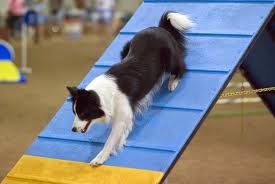
Running Contacts: Running contacts are when the dog continues at full speed and strides down into the contact zone. A true running contact has no deceleration. There are many methods to training this performance. Some include teaching the dog to foot target, or teaching them to control their stride down the contact.

Pros to running contacts:

  • Running contacts take less time for the dog to perform because they never stop until the end, so it will contribute to a faster course time.
  • Running contacts do not put as much physical wear and tear on a dogs body, because we are not asking them to stop on an incline at high speed.
  • For environment sensitive dogs, running contacts keep the dog moving, so they don’t have time to think about the environment and get distracted.

Cons to running contacts:

  • For handlers that need a physical advantage over their dog, running contacts do not give the handler a chance to get ahead.
  • Running contacts take lots of repetitive training and commitment, and will take longer to train consistently than a stopped contact.
  • A running contact performance is not as consistent of a behavior as a stopped contact, it’s nearly impossible to make sure the dogs feet are in exactly the same place each time.
  • Turns off a contact have to be trained very well. The dog must really understand how to run through the contact but turn as soon as they hit the ground.
  • Running contacts make it more difficult for this obstacle to become independent.
Border Collie on A-Frame must "hit" the yellow area in stride

Stopped Contacts: Stopped contacts, usually a “2 on 2 off” behavior, is when the dog stops at the end of the contact with their two rear feet still on the contact, and their two front feet on the ground. The dog would then be released by the handler before continuing forward. There are many methods to teaching stopped contacts. Some include a nose target, while lots of people will shape the behavior.

Pros to Stopped Contacts:

  • Stopped contacts give the handler a chance to get ahead of their dog.
  • Stopped contacts may not take as much training time and commitment as running contacts.
  • There is no question if the dog has hit the contact or not, because they should be stopped in the contact zone.
  • Sequencing off of the contact can be easier because the handler has a chance to position themselves where they need to be. This also means that the dog can turn off the contact with the handler, they don’t necessarily have to be driving straight.
  • Stopped contacts are an easier position to teach independently.

Cons to Stopped Contacts:
  • Stopped contacts add to your course time, because the dog is stopping, even if just for a brief moment.
  • For environment sensitive dogs, stopped contacts give the dog a chance to look at their surroundings, like the judge standing nearby or the busy situation of a trial, which could lead to the dog getting distracted.
  • Stopped contacts require more impulse control for the dog, because they have to wait to be released. A common problem for high drive or fast dogs is that at competition, they are too amped-up to stop.
German Shepherd would allow board to hit the ground in a stopped contact.
His 2 back feet should be on the yellow board with his 2 front feet on the ground waiting for instruction.

These contact positions can always be modified, depending on what works best for your dog. When choosing one for your dog, think about the following things:
  • Is speed something you are concerned with? Do you mind that stopped contacts will take a few more seconds, or do you want the fast running contacts because you want a better course time?
  • How much time are you willing or able to commit to the training? Our lives can be busy and not everyone has the time or place to train every day or even every week. Figure out what time you can commit. Running contacts take more consistent training and more repetition. If you are only going to class once a week, a stopped contact may be more realistic.
  • Figure out what is best for your dog. Is your dog comfortable enough in the competition environment to stop and wait to be released, or is it best for them to keep moving?
3rd Contact Obstacle known as the dog walk.
 The dog should be hitting the yellow at the end of the board before moving on in the course
Regardless of which performance you choose, you can be successful with either one. We’d love to hear your opinions on the different contact positions, and what works best for you! Comment or e-mail your stories to agility@morrisk9campus.com.

Friday, January 24, 2014

Bonding and Building Trust - On training the "ideal dog"


Everyone wants to own their “ideal dog.” Whether that means having a big, playful pup or a small little couch potato, the description of this ideal dog can vary greatly from person to person. Whatever you picture as your perfect pet, people often share one common ideal trait: a dog that listens to you when you ask them to do something.

An obedient dog that pays attention when you say things like, “no jumping on the houseguest,” or “get off the furniture” is always ideal, but the question is, how do you get your dog to listen? The first step is to teach them a command that means a behavior. This is why taking pet training classes with your dog is one of the most essential things you could ever do. 

Through training, you can teach your dog behaviors that will not only help improve their quality of life¸ but it will make your job easier as well. Pet training can also teach your dog behaviors that have the potential of saving their life. Something just as important as pet training itself, however, is you, their human, being involved in your dog’s training.

Being present and active in training is critical in the reinforcement of your dog’s behaviors elsewhere. When you are involved in training, you are building a relationship with your dog that will greatly enhance the bond that you share. Beyond building that bond, training your dog also builds trust. Your pet begins to really understand that you are there to reward them when they do something good. If you are not the one teaching the dog behaviors, your dog never learns that they need to work for you. You have to teach your dog to listen to you, and they need to know when they do listen, they will be rewarded greatly.

More than just being involved yourself, it is important to have as many people in your household participate in training as possible. Having more people in the family involved helps confirm that everyone will be reinforcing similar things. 

Pet training is extremely important for you and your dog, and it’s so crucial that you are involved in your dog’s training as well. In recognition of January as National Train Your Dog Month, Morris K9 Campus realizes the importance of training and owner involvement and has collaborated with six different local shelters and rescues: 11th Hour Rescue, Randolph Animal Pound, One Step Closer Animal Rescue (O.S.C.A.R.), Cold Nose Warm Heart, Mount Pleasant Animal Shelter and Coming Home Rescue. Every dog adopted from these shelters during the month of January can enter for a chance to win one of six 2-month training memberships to Morris K9 Campus! Call or visit these shelters to consider adding a new ideal pet to your family and to enter this exciting contest.

Friday, January 17, 2014

Socialization Window - Helping your puppy grow


Socialization is extremely important when it comes to your young puppy. Puppies may seem happy-go-lucky and invincible, but that behavior will not necessarily translate to adulthood unless you reinforce those behaviors by socializing your dog. Letting dogs learn to interact in new situations as puppies is important because it creates the building blocks to a successful adult dog. 

There are many lifelong benefits to presenting your dog with new scenarios while they are young. Introducing them to other people, other dogs, new situations and different environments while encouraging positive interaction is especially critical during what is called the “Puppy Socialization Window.”

Puppies under sixteen to eighteen weeks old are in this window, which essentially means that puppies are a sponge; they will soak up everything they are exposed to. Failing to socialize your dog during this time period can lead to serious issues, including behavior problems during their adult life. Begin socializing your dog as much as you can during this young age.

“It should be the standard of care for puppies to receive such socialization before they are fully vaccinated,” according to The American Veterinary Society of Animal Behavior. Somewhere between sixteen to eighteen weeks, the puppy reaches their socialization deadline. What your dog has been exposed to prior to this point will shape what type of adult dog your puppy will be.

This is great if you get your dog at a young age, when they are clearly in their socialization window, but what happens if you adopt an older dog who wasn’t socialized as a puppy? Just because you have missed this socialization window doesn’t mean you can’t help your dog, however it will be a much bigger challenge. With an under socialized adult dog, you have to paying close attention to the signals that they give you and make sure you are not intentionally making your dog uncomfortable. Although you want to expose your dog to new things, if they are nervous, they are past the point of becoming used to something new and continued exposure may scare them. Consult the above chart, courtesy of Sara Reusche of paws4u.com and doggie artist Lilli Chin for more information on reading your dog’s signals.

A dog that has been well socialized is able to go out confidently into everyday situations. For those that aren’t, the world can be extremely frightening and this can limit what you will be able to comfortably do with your dog. Get out and allow your dog to interact with other people, pets and places as much as possible, at as young an age as possible. However, if you are having certain issues with your dog, it is best to seek the advice of a professional. Morris K9 Campus offers a variety of different solutions for many issues that you may be having along the way. We offer Free Saturday Puppy Classes for dogs under the age of 20 weeks and fun, interactive training classes to help any dog grow into the well-socialized pet you know they can be.


Friday, January 10, 2014

Dog Daycare Lingo - How to describe play

When you take your dog to daycare, you may hear specific words used to describe your dog’s day during off-leash play. Knowing what the staff means by using these words can be essential to understanding what your pooch is trying to “say” when they are at daycare. Here are five words or phrases that every owner should expect their pet professional to know about off-leash play:
Loose, curvy bodies indicating comfortable dogs.
Appropriate playtime body language between dogs.
Play Solicitation: This term refers to how a dog attempts to get another dog to play with them. It’s a behavior or series of behaviors that a dog will display in order to communicate to the other dog. There are appropriate and inappropriate ways that dogs communicate with each other:
Appropriate: Play bow, light muzzle nudging, wiggly movements
Inappropriate: Humping, growling, barking, incessant muzzle nudging, or nipping
Body language: The way a dog uses their body is like the way people talk to each other. A dog’s ability to read this language is a critical skill for dogs, especially in off-leash play. Dogs need to be able to interpret another dog’s body language as well as being able to clearly display these behaviors themselves. Another dog will recognize stiff body posture as a dog being uncomfortable. Loose, curvy body language indicates that a dog is very comfortable.

Play bowing - a comfortable posture between dogs.
Tolerance: Dogs will do best in the group play environment if they are tolerant of all kinds of dog behavior. This may include some roughhousing with more high-energy dogs or puppies. Tolerance is a skill that is built over time, so attending daycare will help your pet become used to these behaviors. Regular exposure will help increase tolerance, especially as your dog gets to know the other pets in daycare.
Relationship: When dogs get acquainted and have a better understanding of each other, they can form a bond. Daycare essentially creates a virtual home environment, as if the dogs are living together, so they learn to treat each other with affection, love and trust.
Dogs who know and understand each other can enjoy play.
Stiff Body Language indicating that a dog is uncomfortable.
Socialization: Socialization is essential to a dog’s experience in daycare. Forcing a dog that isn’t comfortable with other dogs to participate can actually do more harm than good.  Daycare is best for dogs that love other dogs, as it presents an opportunity to “fine tune” their social skills. They will be exposed to many different breeds with all kinds of personalities. A dog will learn that maybe one friend likes to wrestle but another would rather run around and play chase.
Knowledge of these few daycare terms makes it easier to understand what your furry friend is experiencing. Since our pups can’t speak directly to us, it is through their body language and the application of the terms above that we figure out how they fit into the daycare environment.

The goal of our daycare program is to provide a fun, happy and safe environment by recognizing these terms and behaviors. Think your dog would enjoy off-leash play at Morris K9 Campus? Visit our website or call 973-252-5100 to learn more about doggie daycare.
 

Friday, January 3, 2014

Agility Training - To Compete or Not Compete?


So you’ve been training with your dog in agility for a while and you think you might be ready to compete. But how do you know for sure? The most important thing to remember is that every dog is different. Dogs mature differently and have varying confidence levels. While some dogs are ready to go at 15 months (the minimum age in most agility venues to start competing), others may need more time. There are many things to consider when deciding to compete for the first time. Take the following steps to help determine if you and your pooch are ready to move forward.

Get your dog comfortable in the environment. Lots of agility trials are held in barns or at indoor sports facilities with surroundings dogs have never encountered before. Your dog must be comfortable around unfamiliar dogs, people and noises in different situations. Agility trials can also get very loud and crowded, so it’s important that your dog is exposed to that prior to competing. 

When you first get a new dog - puppy or older - consider taking them with you when you travel, especially if you already attend agility events. Most show grounds allow puppies older than four months. Exposure to this kind of stimulus in a positive way will help your dog become more at ease with things they will encounter during their future agility career.

Have a solid set of skills. Prior to competition, your dog should be able to accurately complete all obstacles to the criteria you have chosen. For example, if you have trained a stopped contact, your dog should perform that behavior with confidence anywhere. If a dog is unsure on an obstacle, competition could make them even less sure of themselves and could result in the dog shutting down.  

Attend a Match or Run-Thru. Test your pet’s confidence with an agility match show or run-thru. This is basically a fake trial; it gives your dog exposure to agility in another location while being around other people and dogs. Most places allow you to use training aids during these events, such as food, toys or clickers. Keep these trial sessions short, successful and happy. 

Morris K9 Campus offers run-thru’s and match-style competitions for agility training participants to provide them with a chance to practice. If you feel ready to take the next step, consider signing up for one of our upcoming trials. 

Don’t be nervous! As a handler, sometimes your first competition can be nerve wracking. Be careful of getting too nervous at the match. Dogs pick up your emotions, so being nervous is not going to help your dog. Try to remember this is only a game, and that no matter how your run goes, there are people there to support you. 

Choose the right trial. Once you feel confident in yourself and you are seeing confidence and performance from your dog , you are ready to find a trial to enter! Smaller trials are often a little less intimidating. Some clubs even hold Novice only trials. Ask around and see what facilities people recommend for beginner dogs if you haven’t been to one before. 

Record and report. After your trial, report back to your instructor about how things went. It’s always a good idea to find someone to videotape your run. If things went well, pick a few trials to go to next. You don’t want to overwhelm your dog, so stick with the occasional trial to start. If things didn’t go as well as you hoped, make a training plan and try again later. There will always be trials to go to, so don’t rush it. Let your dog blossom at their own rate, and as always, enjoy the time spent together. At the end of the day, agility is a sport that can and should be enjoyed by all participants.

Thursday, December 26, 2013

Helping Your New Dog Feel at Home


Amidst all the hustle and bustle of the holidays, everyone wants a place to relax and feel at home. For those of us with a new dog during this time of year, we can’t forget our pets in preparing for a comfortable holiday! If you recently added four legs to your family, make sure that through all of the holiday festivities, you do your best to get your dog acclimated. Here are five holiday helpers in order to make the transition a little bit easier.

Management Always stay one step ahead of your dog. Whether you brought home a puppy or an adult dog, many objects in their new environment will be tempting. Think about the possible scenarios your dog could get into and manage them accordingly. For example, remember that keeping the Christmas ham out on the counter could entice your dog to jump up and take a lick. If you are unable to watch your dog every second, you’ll want to keep them out of the kitchen or keep the food in a safe spot.

Dog Proofing For the holidays, don’t give your new dog free reign of the house. This leaves the possibility open for your pooch to get into mischief, such as eating the holiday dinner, using the Christmas tree as a spot to relieve themselves or unwrapping presents from under the tree. Holiday decorations are a common pet hazard and should be kept out of reach of your dog. Also be careful with household cleaning products, wires, children’s toys or anything else that could be potentially hazardous to your pet.

Teachable Moments Always be on the lookout for teachable moments, or any moment when your dog does something for which they should be rewarded. A good way to do this is to have small treat containers randomly dispersed throughout the house. This allows you to take advantage of any teachable moment with treats readily available. A good example would be a dog that jumps. If your dog likes to jump on strangers but sits nicely instead, grab a treat and reward! It would be great to keep a treat box by the door for such an occasion.

Routine Just like humans, dogs thrive on routine. In order to get your dog adjusted to your new home, you will want to keep a regular schedule. The more you stray from your routine, the longer it will take for your dog to get comfortable. The holidays are always busy, so make sure to remember your dogs feeding and potty times. Your dog has come to rely on the schedule you have started and altering that schedule can confuse them.

Affection Your dog is so happy to have a new home and family this holiday season. However, as you can imagine, this is also stressful for your new pooch. It is important to shower your dog with affection so they begin to bond with you. A belly rub is a great way to show your dog some love and affection. Just remember that your dog still getting to know his new family. Therefore, you will want to stay away from too many hugs and coddles, as this can make your dog a little stressed. Learn to recognize the signs of a stressed dog so you know what to watch out for.

Congratulations on the new addition to your family! Keep in mind it can take up to 12 weeks for your new family member to become completely adjusted to their new life. For help training your new pet into the perfect dog for your family, you can find socialization, training tips and more at Morris K9 Campus. As you get to know your new dog, remember to have fun and enjoy the journey!